
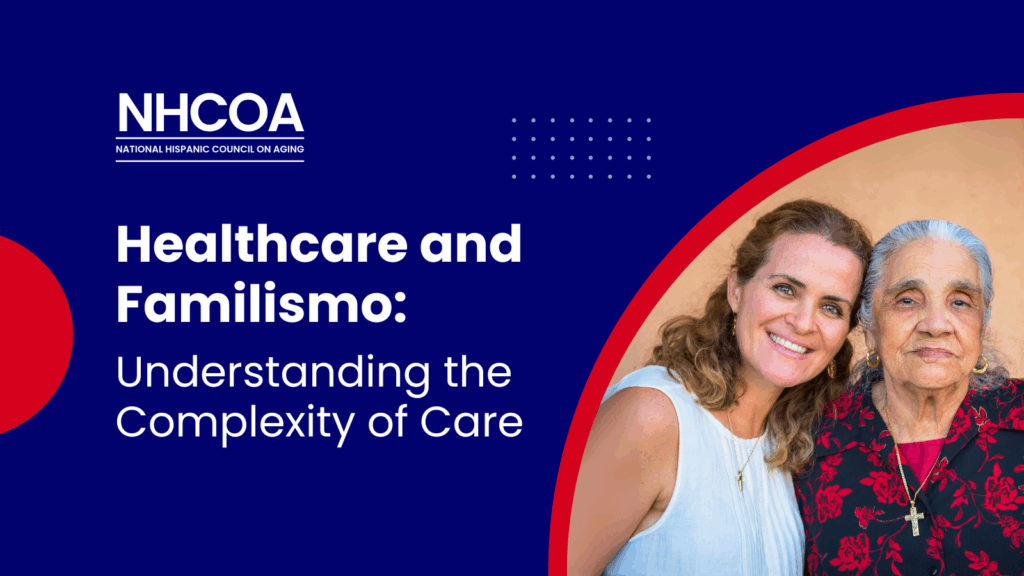
If you’ve been following NHCOA’s series on Working with Hispanic Americans, you may have already read about the concept of familismo (familism). It appears most often in the form of caregiving relationships, wherein a family member will take on the role of an informal family caregiver to a loved one, due to a medical status that leaves them vulnerable. These family caregivers take on a great deal of responsibility, and tend to be highly involved in their loved ones’ medical decisions.
Let’s take a magnifying glass to this cultural staple of the Hispanic American community, to understand how it can affect the healthcare of many Hispanic Americans, of any generation. For medical professionals treating Hispanic Americans, it’s incredibly important to understand how advice, prescriptions, and treatments are understood and implemented.
In Hispanic American households there is a great sense of dedication and loyalty to one’s family, which at times might surpass what you ordinarily expect out of a family’s involvement in a patient’s care. This could mean that there are several family members in the room with you and the patient, whose participation in the appointment can vary. In this case, a patient may look to their family when it comes to important decisions regarding their personal treatment.
But even if it’s just the patient in the room, familismo is likely still playing a powerful role in the patient’s medical care. It can even affect a patient’s adherence to a treatment plan. If a Hispanic American family operating on a tight wallet, the patient may be inclined to defer from a treatment, as they put their family’s needs above their own. Whether the drug’s fees are too expensive, the time required of the treatment’s clashes with their work schedule or the needs of a child, or perhaps they’re a family caregiver putting their loved one’s health first—medical providers must understand this cultural phenomenon to understand the adherence of their patient’s treatment, and the needs they have that maybe aren’t being spoken aloud.
If you’re a medical professional working with Hispanic American patients, consider these tips to better cooperate and work around familismo:
- If a facility doesn’t have any bilingual personnel, consider whether an interpreter would be beneficial to the patient’s communication. An interpreter may be able to help with culturally sensitive communication as well.
- Consider the help of a Community Health Worker (CHW); your patient’s community may have a trusted individual who can provide guidance with their treatment that accommodates for the impact of familismo.
- Give your patient time to discuss their treatment with their family. Hispanic Americans tend to hold a great deal of respect for medical professionals, which could mean a hesitancy to discuss the treatment until they’ve left the medical facility. If that discussion can happen on the premises, medical professional may find easier cooperation.
Taking the time to understand familismo will go miles for a medical professional’s cultural competency in working with Hispanic Americans, which can be the difference in compliance and effective treatment.
The National Hispanic Council on Aging is proud to be a trusted voice advocating for Hispanic American communities, and we use our standing to help these communities reach and learn about available forms of aid. We are excited to engage fellow organizations that find commonality in these values, so that we may overcome these challenges together.
For more tips on how to best work with the Hispanic American community, we encourage you to check out our webinar on the subject, titled “NHCOA’s ‘How to Successfully Engage and Work with Latinos’ Webinar,” on YouTube.
Do you want to learn more about Hispanics and Latinos, how to work with this wonderful community, and how to support the community programs that allow them to prosper? Consider reaching out to the National Hispanic Council on Aging Resource Center, by phone call or WhatsApp, at (202) 658 – 8664. The NHCOA Resource Center is a multilingual hub that educates and empowers community members and constituents with accurate information and helpful resources.
This publication is supported by the Administration for Community Living (ACL), U.S. Department of Health and Human Services (HHS) as part of a financial assistance award totaling $210,023 with 67 percentage funded by ACL/HHS and $70,240 amount and 33 percentage funded by non-government source (s). The contents are those of the author (s) and do not necessarily represent the official views of, nor an endorsement, by ACL/HHS, or the U.S. Government.
Recent Comments