
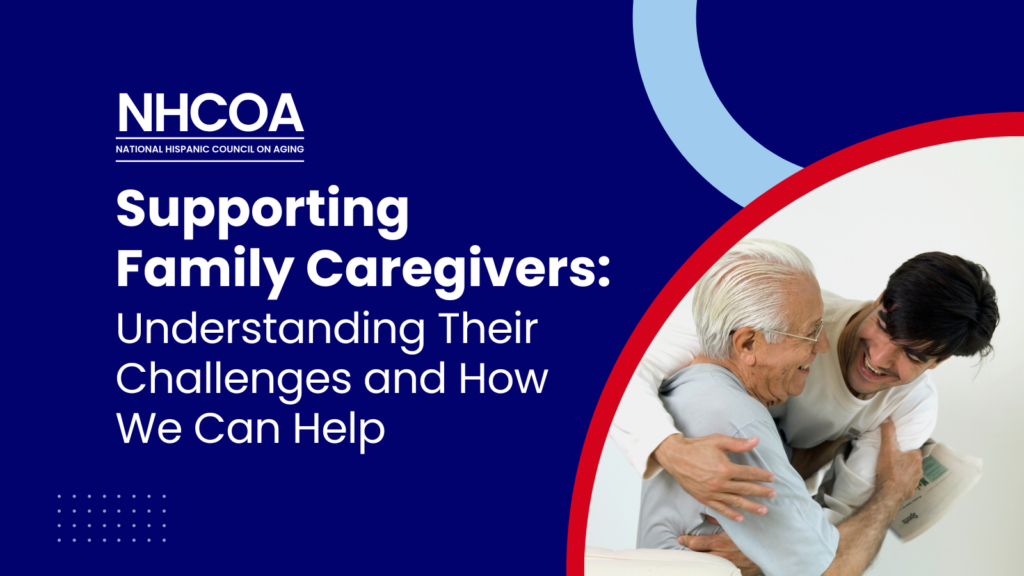
Family caregivers are the backbone of long-term care for millions of older adults across the United States. Every day, they provide essential support to their loved ones, often without pay and while balancing work, family responsibilities, and their own personal needs.
For many Hispanic and Latino families, caregiving is more than a responsibility; it is a reflection of deeply held cultural values that emphasize caring for loved ones across generations. While these traditions foster strong family bonds, they can also make caregiving physically, emotionally, and financially demanding.
At the National Hispanic Council on Aging (NHCOA), we recognize the vital role family caregivers play in helping older adults live safely and with dignity. We also know that caregivers need support, resources, and encouragement to care for themselves while caring for others.
Understanding the Challenges of Family Caregiving
Caregiving often extends far beyond helping with everyday tasks. Depending on a loved one’s needs, caregivers may assist with personal care, prepare meals, manage medications, coordinate medical appointments, provide transportation, handle finances, and offer emotional support.
As a person’s health changes—particularly when living with Alzheimer’s disease or other forms of dementia—the responsibilities of caregiving often become more complex. Many caregivers find themselves learning new skills, navigating healthcare systems, and making difficult decisions while managing their own households, careers, and families.
Family caregivers take on these new skills and meet these new challenges, often at the expense of their physical, emotional, and financial well-being. When we consider families and communities that may already be financially struggling, we must also recognize that family caregivers may be falling short of the standard of care they wish to deliver, despite their best efforts. It is no wonder that these responsibilities can devastate a caregiver’s health.
The Physical and Emotional Impact
Providing care for a loved one can be deeply meaningful, but it can also be emotionally and physically exhausting. Research shows that family caregivers are more likely to experience:
- Chronic stress
- Anxiety and depression
- Sleep difficulties
- Social isolation
- Physical fatigue
- Financial strain
Many caregivers become so focused on meeting the needs of others that they postpone their own medical appointments, neglect healthy habits, or withdraw from activities they once enjoyed. Without support, these ongoing demands can increase the risk of caregiver burnout.
Recognizing the Signs of Caregiver Burnout
Burnout develops when the demands of caregiving become overwhelming over time. Recognizing the warning signs early can help caregivers seek support before their health is significantly affected.
Common signs include:
- Frequent Exhaustion
- Becoming easily frustrated or overwhelmed
- Changes in sleep or appetite
- Difficulty concentrating
- Feeling isolated or alone
- Losing interest in hobbies or social activities
- Frequent feelings of sadness, anxiety, or hopelessness
These experiences are common and deserve attention. Seeking help early can improve both the caregiver’s well-being and the quality of care they provide.
NHCOA’s Caring for the Caregiver Training Program
We are proud to offer a training to caregivers designed to connect them with available resources, means of support, and practices for self-care. Challenges can arise from so many different factors, and at any time for a family caregiver, and NHCOA’s Caring for the Caregiver Training Program is an excellent opportunity for you to bolster your skills and lighten the burden of caring for a loved. These trainings include a broad span of educational sessions and expert speakers from such important topics as Alzheimer’s disease, and other chronic illnesses.
For additional help, consider the National Hispanic Council on Aging (NHCOA) Resource Center, available by phone call or WhatsApp at (202) 658 – 8664. The NHCOA Resource Center is a multilingual hub that educates and empowers community members and constituents with accurate information and helpful resources. Our resource center is designed to offer tools, resources, and education for family caregivers and professionals who support older adults and people with disabilities. You can also consider Best Programs for Caregivers (BPC), a free online directory of available resources, at bpc.caregiver.org.
Be sure to check out NHCOA on X, Facebook, and Instagram using @NHCOA to connect with us over caregiving, and so much more.
This publication is supported by the Administration for Community Living (ACL), U.S. Department of Health and Human Services (HHS) as part of a financial assistance award totaling $210,023 with 67 percentage funded by ACL/HHS and $70,240 amount and 33 percentage funded by non-government source (s). The contents are those of the author (s) and do not necessarily represent the official views of, nor an endorsement, by ACL/HHS, or the U.S. Government.
Sources:
- National Institute on Aging. “Caregiving in the Latino Community Infographic.” Accessed July 6, 2026. https://www.nia.nih.gov/research/alzheimers-dementia-outreach-recruitment-engagement-resources/caregiving-latino-community.
- Aranda, Maria P., Adit A. Ginde, Noelia G. Perez, Teresa Molina, Vanessa G. Hooper, and Sid E. O’Bryant. “Comprehensive Understanding of Hispanic Caregivers: Focus on Innovative Methods and Validations.” Journal of Alzheimer’s Disease Reports 7, no. 1 (2023): 557–574. https://doi.org/10.3233/ADR-220094.
Recent Comments